AI Watermark Checker vs AI Detector: What's the Difference?
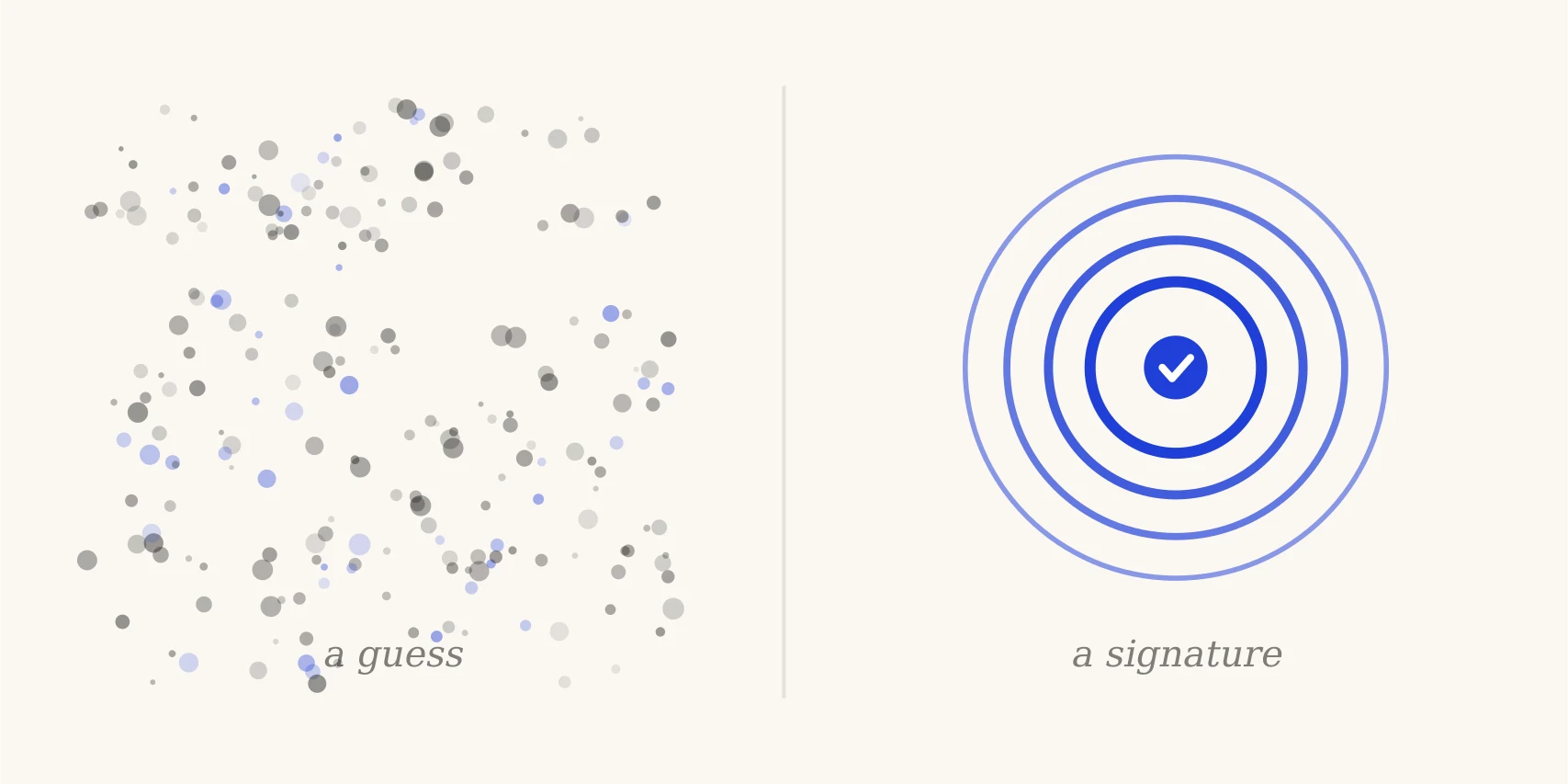
Four very different technologies get collapsed into the phrase “AI detection”, and the confusion is not harmless: students get accused by tools that guess, and stripped metadata gets read as proof of innocence. Here is the actual taxonomy.
1. AI classifiers (“AI detectors”)
What they are: statistical models trained to guess whether text or an image looks AI-generated — burstiness, word-choice patterns, pixel statistics.
What they output: a probability. “92% likely AI.”
The problem: they are guesses with meaningful error rates in both directions. Non-native English writers get flagged; lightly edited AI text passes. No provider attests to the result, and two detectors regularly disagree about the same text. OpenAI discontinued its own AI-text classifier back in 2023 for exactly this reason.
This site deliberately does not offer one.
2. Provider watermarks
What they are: signals a provider deliberately embeds at generation time — Claude’s imperceptible text watermark, Google’s SynthID in images, video, audio and Gemini text, the SynthID layer OpenAI embeds in ChatGPT images.
What they output (when verifiable): a provider-backed statement — “this carries our mark” — with known reliability, sometimes cryptographic, sometimes statistical with tight bounds.
The catch: today these are mostly verifiable only by the provider. Google checks SynthID via Gemini and a waitlisted detector portal; Anthropic’s third-party detection is announced but not yet released. A tool that claims to detect them without provider access is bluffing — which is why our provider pages show status, not simulations.
“Watermarking over 100 billion images and videos and 60,000 years of audio.”
— Google · scale of SynthID deployment · May 2026
3. Hidden Unicode characters
What they are: invisible code points — zero-width spaces, word joiners, soft hyphens, unusual spaces — physically present in text. Some tools and workflows insert them as fingerprints; word processors and chat interfaces insert them by accident.
What they output: deterministic facts. “Three U+200B at positions 148, 772, 804.” Same input, same result, verifiable by anyone — check any text yourself.
The catch: presence of hidden characters ≠ AI. Absence ≠ human. They are evidence about the text’s journey, not its author — and they are not how modern AI text watermarks work.
4. C2PA Content Credentials (provenance)
What they are: cryptographically signed metadata attached to files — who created them with what tool, and what edits followed. An open standard anyone can verify, adopted by Anthropic, OpenAI, Google, Adobe and camera makers.
What they output: verified provenance. “Signed by X, generated by Y, source type: trained algorithmic media” — validate any image locally here.
The catch: metadata can be stripped by screenshots, edits and platforms. A missing credential is the absence of evidence, never proof of human origin.
The comparison in one table
| Verifiable by anyone? | Deterministic? | Provider-backed? | Survives edits? | |
|---|---|---|---|---|
| AI classifier | yes, but it’s a guess | no | no | n/a |
| Provider watermark | not yet (provider-only) | — | yes | designed to |
| Hidden characters | yes | yes | no | until removed |
| C2PA credentials | yes | yes | yes | breaks visibly |
What this means in practice
If someone claims “this text is AI” based on a classifier score, the correct response is: that is a guess, sourced from a tool with a known false-positive rate. If a file carries a valid Content Credential declaring trained algorithmic media, that is evidence — signed and checkable. The gap between those two statements is the entire reason this site exists, and the standard we hold every result to is written up in our methodology.
Try it on something real: text checker · image checker.